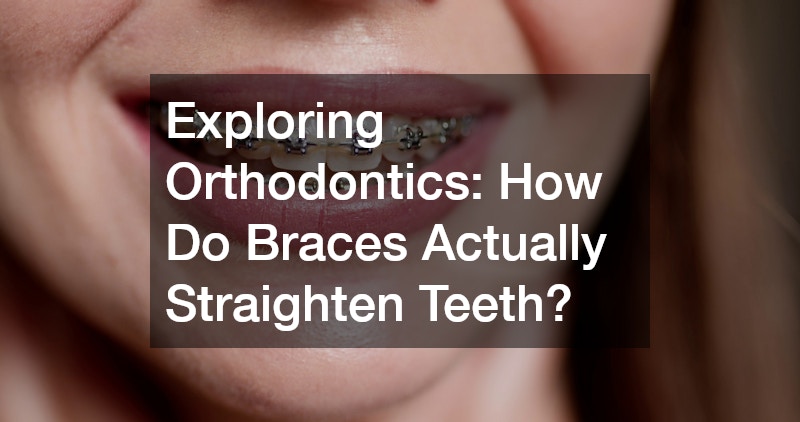
When you see someone with a newly straightened smile, it is easy to assume that braces simply “push” crooked teeth into a neat, tidy line. But if you pause to think about it, teeth are anchored into dense, solid jawbone. How can a thin metal wire shift an entire set of teeth without snapping them off or damaging the jaw?
The answer lies at the intersection of bio-engineering and cell biology. Modern orthodontics relies on a biological process called bone remodeling. Braces do not force teeth through bone through brute strength; instead, they signal your body to safely dissolve bone in front of a tooth and build fresh bone behind it.
Here is a look at the fascinating science, mechanics, and biological magic behind how braces actually straighten teeth.
Teeth Aren’t Concrete: They’re Anchored by Living Tissue
A common misconception in orthodontics is that teeth are fused directly to the jawbone like posts set in concrete. In reality, teeth sit inside sockets within the jaw, suspended by a dynamic, fibrous tissue known as the periodontal ligament (PDL).
Think of the periodontal ligament as a miniature hammock made of collagen fibers, blood vessels, and specialized nerve endings. The PDL acts as a natural shock absorber whenever you chew, allowing your teeth to handle heavy bite forces without fracturing.
More importantly, the PDL contains specialized cells that react instantly to pressure. When an orthodontic force is applied, this ligament compresses on one side and stretches on the other, kicking off the tooth-moving process.
The Biological Engine: Osteoclasts vs. Osteoblasts
To understand how teeth shift, you need to look at what happens at the microscopic level. When braces place light, continuous pressure on a tooth, the periodontal ligament senses the physical stress and releases chemical signaling molecules.
This signal recruits two key types of specialized cells:
- Osteoclasts (Bone Breakers): On the compression side, the direction in which the tooth is being pushed, the squeezed ligament signals osteoclasts to break down existing bone tissue. This process, called bone resorption, clears a pathway for the tooth root to advance.
- Osteoblasts (Bone Builders): On the tension side , the gap left behind as the tooth moves forward, the stretched ligament signals osteoblasts to lay down new bone tissue. This bone deposition fills the void and secures the tooth in its new position.
Because bone resorption occurs slightly faster than bone deposition, teeth can feel slightly loose during active orthodontic treatment. This is completely normal: your jaw is actively restructuring itself around your moving teeth.
The Anatomy of Braces: How the Hardware Delivers Pressure
While cellular biology does the heavy lifting beneath the gums, the physical hardware of braces acts as the precision guidance system above. Every component plays a distinct role in guiding movement:
Brackets
Brackets are small squares made of stainless steel, ceramic, or titanium bonded directly to the front of each tooth using a dental adhesive. Brackets do not move teeth by themselves; they serve as handles that give the wire a secure point of leverage.
The Archwire
If brackets are handles, the archwire is the motor. This thin metal wire runs through each bracket slot. Archwires are pre-formed into an ideal, symmetrical arch shape. When tied into crooked teeth, the wire bends to fit the current misalignment. As it naturally tries to spring back into its pre-set shape, it transfers steady, controlled pressure to the brackets.
Early in treatment, orthodontists use flexible nickel-titanium wires that re-shape easily. Later on, stiffer stainless-steel wires are introduced to make precise adjustments.
Ligatures (Elastics)
Ligatures are tiny rubber bands or thin wire ties that secure the archwire inside the bracket slots. (Self-ligating braces use built-in sliding doors instead.)
Auxillary Elastics and Power Chains
To correct bite alignment (such as an overbite, underbite, or crossbite), larger rubber bands are hooked between the upper and lower arches. Power chains, connected strings of elastic rings, are used to pull multiple teeth closer together and close stubborn gaps.
The Three Stages of Treatment
Moving teeth is a marathon, not a sprint. Attempting to move teeth too quickly with excessive force can damage tooth roots or cut off blood supply to the periodontal ligament. Orthodontic treatment is carefully executed across three distinct phases:
- Stage 1: Leveling and Aligning
- What Happens: Rotated or crowded teeth are brought into a single smooth arch line.
- Objective: Straightening the crowns and fixing severe crookedness.
- Stage 2: Bite Correction & Space Closure
- What Happens: Upper and lower teeth are coordinated to fit together functionally.
- Objective: Closing extraction spaces and fixing overbites or underbites.
- Stage 3: Fine-Tuning & Detailing
- What Happens: Individual tooth roots and angles are micro-adjusted for long-term stability.
- Objective: Perfecting the aesthetic presentation and functional bite contact.
Regular adjustment appointments, typically scheduled every 4 to 8 weeks, allow the orthodontist to replace worn-out elastics, adjust wire tension, or switch to thicker archwires to keep bone remodeling active.
Why Retainers Are Essential: Preventing Relapse
Once the brackets come off and your teeth look perfectly aligned, the biological process is not quite finished. Bone remodeling takes time to solidify.
When braces are removed, the bone around your newly positioned teeth is still relatively soft and malleable. Furthermore, the elastic collagen fibers in your periodontal ligament have a “memory” and will attempt to pull the teeth back toward their original locations, a phenomenon known as orthodontic relapse.
Retainers hold the teeth firmly in place while new mineral deposits harden the surrounding jawbone and allow the periodontal fibers to adapt. Wearing a retainer as prescribed ensures that your hard-earned results remain permanent.
A Fusion of Science and Art
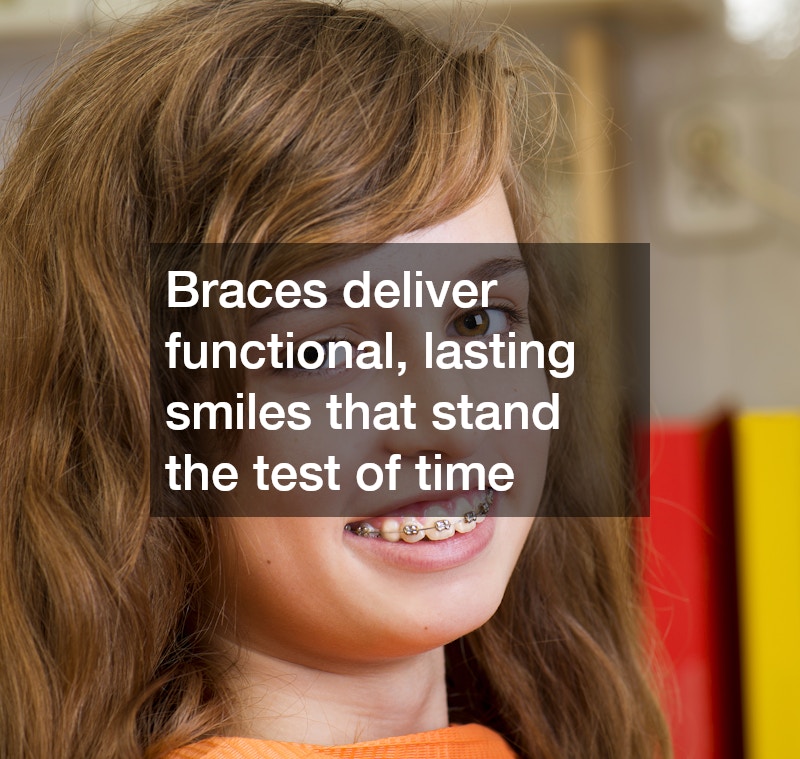
The journey to a healthier smile through orthodontics is much more than cosmetic engineering. It is a carefully orchestrated biological transformation that leverages your body’s natural cell mechanics to reshape bone safely. By combining precise mechanical principles with the power of human biology, braces deliver functional, lasting smiles that stand the test of time.